
With the conclusion of Super Bowl 59, the 2024 NFL season officially came to a close. It marked the long eight-month wait until Week 1 for most NFL fans. For others, this signals the beginning of the offseason. The Chicago Bears and their fans have learned to enjoy the offseason, where they’ve been more interesting than when meaningful games are played. With a combined 15 wins over their last three seasons, changes were needed after their (5-12) finish.
New head coach Ben Johnson and his recently assembled coaching staff should bring new ideas to the Windy City. Although the directive will be apparent during the acquisition period, it will be interesting to see how this new coaching staff evaluates the current roster. The primary focus of the offseason should revolve around both sides of the trenches but don’t sleep on a few splash moves in other areas.
Assistant General Manager Ian Cunningham’s immediate future in Chicago has now been resolved after the Jacksonville Jaguars named James Gladstone their new general manager. Although many considered Cunningham the favorite for the job, the Bears will not receive a fifth pick in the Top 100. For now, we’ll use Over The Cap’s projected draft order, which accounts for all compensatory picks around the league. I used a combination of big boards for the Top 100. I favored Bleacher Report’s Top 175 for the early rounds and leaned heavily on Pro Football Focus’ extensive list for the later rounds. These rankings will drastically change over the next two months, but for now, I had to work with this to keep myself “honest”.
It’s worth noting that free agency is exactly weeks away, which will change the team’s needs. All we can do for now is work with what we’ve got. I’ll try to use some projections regarding how I believe the Bears will attack the draft. Especially this early in the process.
1st (#10) DE James Pearce Jr. (Tennessee)
It feels like the Bears are stuck in a little bit of no man’s land regarding the 10th overall pick in April’s draft. While I expect that free agency will help define their top needs, there’s not really one player that stands out to me as “the pick” this early in the process.
For the sake of this process, I’m projecting that the Bears will spend two considerable free agent resources on the interior line. Whether that’s two guards or a combination of a guard and center is TBA. A lot of that should find clarity in the coming weeks when we get a better idea of who will hit the free-agent market.
For now, I’m going edge rusher. Heading into the draft season last September, it appeared that Pearce would be the top man off the board. After a somewhat uneven final year, his status is more in doubt where he’ll go in the first round. For full disclosure, I don’t love any of the Bears’ options at No. 10 overall but for now, I’m going to project Pearce. His skinnier frame is my biggest question when it comes to fit in Dennis Allen’s defense but to me, he’s the best pure (and proven) pass rusher in this class. He also has the height in length that Allen normally covets. We’ll see if he lights up the combine this week but he’s one of the few names in this spot where I could see him living up to his draft potential. His upside is undeniable.
2nd (#39) iOL Grey Zabel (North Dakota State)
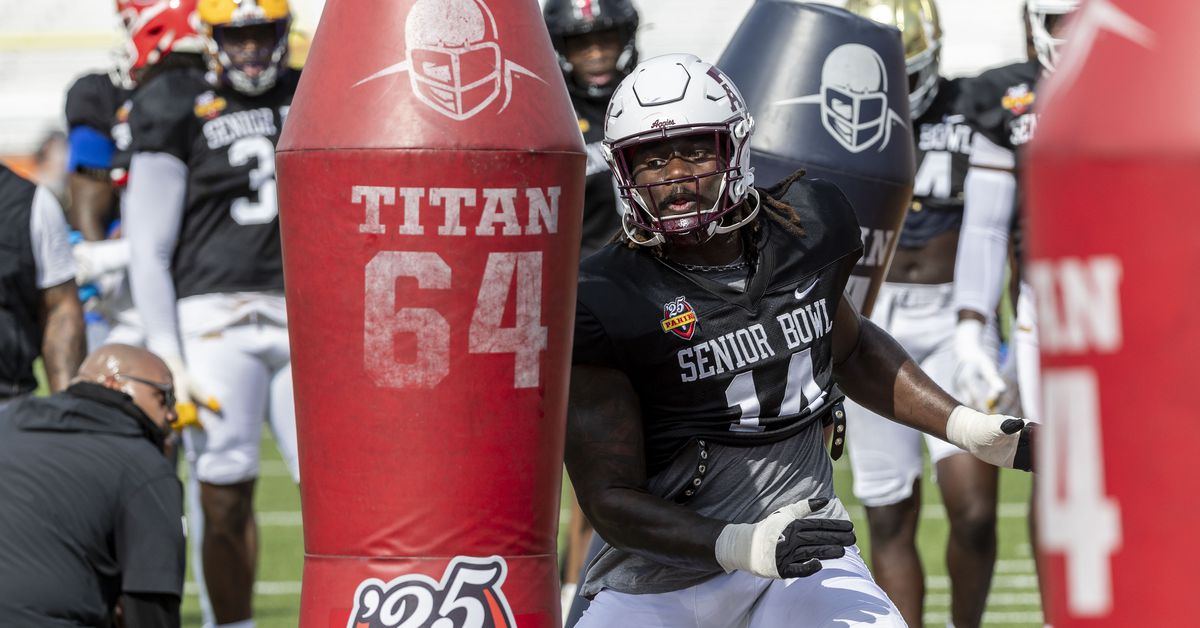
Like I said at the top, the trenches should be a significant focus this offseason. This roster needs help virtually everywhere on both sides of the line. Assuming they land two plus starters on the interior offensive line, they’ll need to draft another interior offensive lineman with versatility. Enter Zabel. The man was the talk of the Senior Bowl. He dominated one-on-one drills and made himself quite a bit of money.
Like Graham Barton last year, Zabel was primarily asked to play tackle at North Dakota State but will slide inside to either guard or tackle at the next level. At 6 ‘5 and 316 pounds, Zabel is a physical run blocker who should benefit from the move inside to guard when it comes to pass protection. He’ll need to add some NFL strength along the way, but he has the versatility to play either guard or center, and the upside is that he can become one of the better long-term pieces along this Bears offensive line.
2nd (#41) DL Tyleik Williams (Ohio State)
Trenches, trenches, and more trenches. Although Johnson might steal the headlines regarding coaching additions, don’t underestimate Allen’s input on the defensive side of the ball. In some ways, Allen’s defensive philosophies are similar to those of former head coach Matt Eberflus, both like bigger and longer edge rushers. Where things get different is on the interior. Allen prefers larger interior lineman who can defend the run and rush the passer. With Gervon Dexter Sr. and Andrew Billings already in the mix, depth and size will be a focus on the interior.
Make no mistake, this is a deep class for interior defenders. Although many of the respected draft analysts have their rankings all over the place, one thing remains likely: There will be some top talents in the second round. That’s where Williams comes in. Although he’s only 6’2, the 322-pound lineman was a game-wrecker on an elite Ohio State defense. Right now, he’s more of a run stuffer, but the expectation is that his pass-rushing ability will improve with more development. Williams is a very smart and instinctive player outside his physical tools. It might take him a year or two to develop into a game-changer, but he should be an immediate contributor with rotational depth as the third defensive tackle with upside to do more in Year 1.
Samantha Madar/Columbus Dispatch / USA TODAY NETWORK via Imagn Images
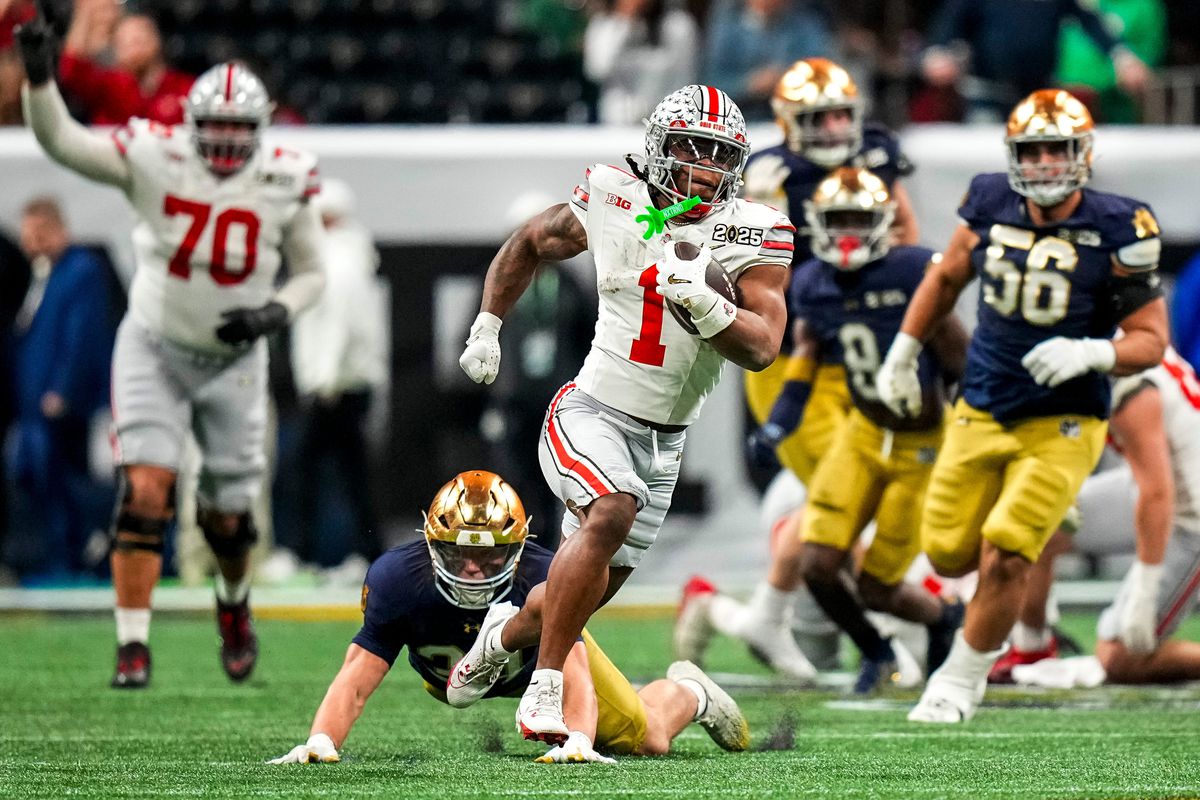
3rd (#72) RB Quinshon Judkins (Ohio State)
Back-to-back Ohio State players? Yeah, you read that right!
While I fully expect a healthy dose of new talent on both sides of the line, Johnson will need certain personnel upgrades elsewhere to run his offense effectively. I may be wrong, but my gut tells me that running back will be high on his priority list. Assuming they keep D’Andre Swift around in 2025, there’s a good chance that the team’s head coach will want to upgrade over Roschon Johnson.
Looking at the success of Johnson’s offenses in Detroit, a lot of that was set up by the run game. Swift provides some of the burst that a role like Jahmyr Gibbs would call for, but they’ll need a more consistent power back that can be relied on to take the physical load. Judkins is that player. He has an eerily similar playing style to David Montgomery, with a lot fewer touches coming out of college. The Ohio State product doesn’t have top-end speed, but he’s a well-rounded back with excellent contact balance and a violent run style.
It’ll likely take a year or two for Johnson to upgrade his run game to his liking, but Judkins is a good start, especially in a historically deep running back class like this.
5th (#149) WR Pat Bryant (Illinois)
In an ideal world, the Bears would have received a compensatory pick for Cunningham, which would have landed them an extra pick at #99. That would have been a prime spot to take a tight end in a deep class. In this exercise, there are no tight ends worth taking in the fifth round, so it’s time to add some upside and depth to the receiving room. That’s where Bryant, the Illinois product, comes in.
The 6-foot-3 senior had career-highs in yards (984), touchdowns (10), and yards-per-reception (18.2). Although I’m not sure Bryant will ever profile as a legit WR1 at the NFL level, he’s a polished route runner with the frame to become a dangerous second or third target. He has good hands and is dominant at the point of attack, especially in 50/50 situations. Bryant will need to improve release off the line of scrimmage, and his lack of speed will hurt him as a deep threat. In the fifth round, teams are looking for role players they can develop into situation specialists. That’s exactly the profile that a player like Bryant would give the Bears.
6th (#204) S R.J. Mickens (Clemson)
Safety is another interesting position for the Bears heading into the offseason. Kevin Byard will be 32 before the start of Week 1. Jaquan Brisker looked considerably improved before missing the last half of the season with his third NFL concussion. There are a lot of unanswered questions there, which could lead to a surprise move or two in the coming months.
If Allen values one thing in his defensive backs, it’s versatility. That’s where Mickens comes in. The former four-star recruit has plenty of starting experience. He’s best at safety but can play in the nickel. He’s a physical player with good scheme versatility. Although he might take some time to adjust to the NFL level, there’s plenty of upside here, and he could be a chess piece for this new defensive staff.
7th (#236) iOL Joshua Gray (Oregon State)
It feels like it’s been a while since the Bears have had a seventh-round pick. As of now, they are projected to have two in late April’s draft. Typically, these are essentially lottery tickets that go toward players that a team would want to make a top priority in undrafted free agency. What better way to spend one of those picks than someone their new assistant offensive line coach is familiar with? Gray fits the size profile and played in 56 games throughout college. Right now, he’s a better pass blocker than he is in the run game, but with the proper development, he could round into a quality piece on a deeper offensive line. The former Beaver has shown plenty of versatility, but his overall skill set will likely be at guard.
7th (#243) RB/WR Donovan Edwards (Michigan)
If you’re a college football fan, you’re probably very familiar with Edwards. He became the NCAA CFB 25 cover athlete and was well-respected during his time at Michigan. As an NFL prospect, I have some questions about fit. He’s a versatile runner who could transition into more of a receiving role at the next level. He doesn’t possess many tools as a runner, but once he gets the ball in open space, he becomes a playmaker. Any team that drafts him will need to have a defined plan in place, but a role on special teams and a chance to become a dual-threat back on specific packages should be enough to get him on the field early in his NFL career. His pass blocking will need to improve, as will his toolkit as a running back against more complex defensive fronts.